A Historic Price Surge Driven by Global Demand
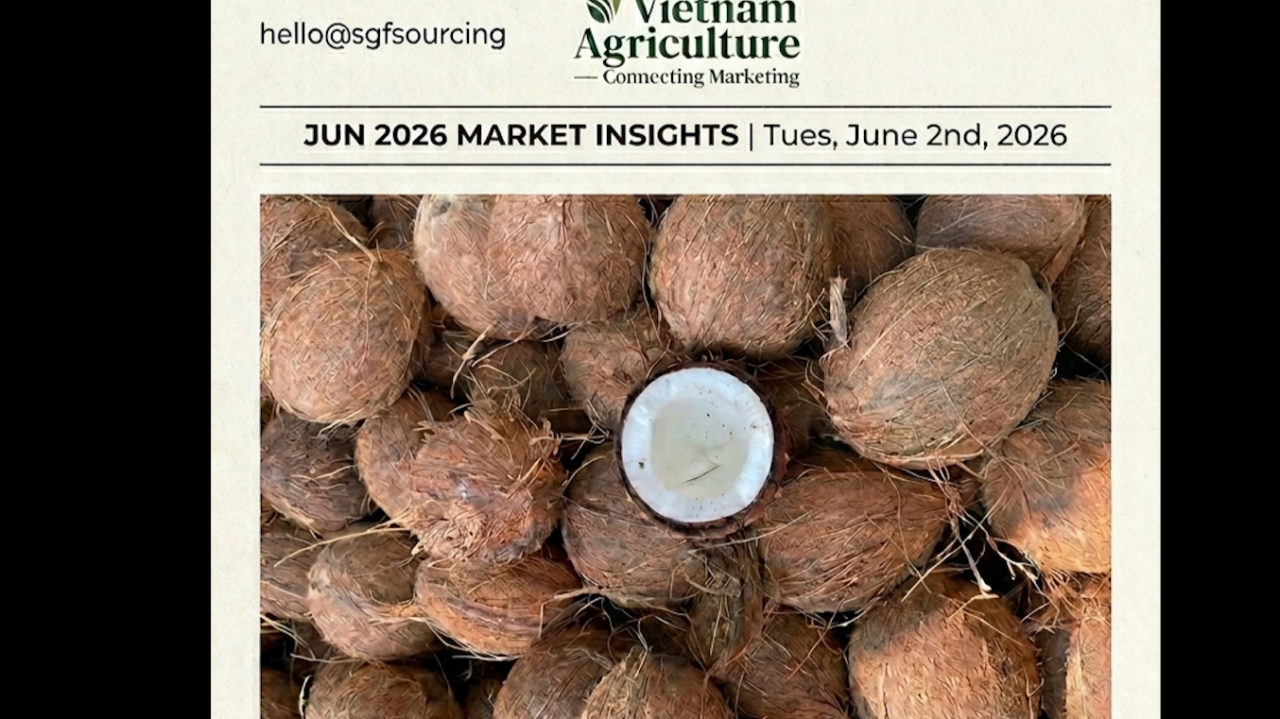
The Vietnamese coconut industry is experiencing an unprecedented boom. Coconut prices have surged sharply, driven primarily by the booming export market and the official opening of high-standard markets, including the United States and the European Union (EU).
This expanding global footprint has caused domestic raw material prices to skyrocket to record levels, drastically altering the market dynamics for local growers and processing enterprises.
Current Market Situation
Between mid-April and early May 2026, the Vietnamese agricultural market witnessed an unprecedented "price rally" for fresh drinking coconuts in its western heartland — the Mekong Delta. Within just the first two weeks of April, farmgate prices nearly doubled, setting a historic benchmark.
This sudden price shock is far more than a routine seasonal fluctuation. Through the macroeconomic lens of Vietnam Agri & SGF Sourcing, this phenomenon represents a convergence of macroeconomic levers, global supply chain imbalances, and an exponential boom in official fruit exports.
Market Outlook: May – August 2026
Based on biological forecasting models and agricultural cycles inherent to the Mekong Delta, the fresh coconut market is projected to experience relief in supply pressures throughout late Q2 and early Q3 2026.
Double-Edged Sword: Exporters Face Tough Challenges
While higher prices bring immense joy to local farmers, Vietnamese exporters are currently facing a wave of new challenges:
- Raw Material Competition: The fierce competition for high-quality raw coconuts (such as raw dried coconuts used for producing desiccated coconut) has intensified, making procurement more difficult.
- Capital and Pricing Pressure: With raw material prices soaring to peak levels, exporters require much larger capital flows to secure inventory.
- Strict Quality Standards: Meeting the rigorous phytosanitary, packaging, and quality regulations demanded by the US and EU markets remains a steep learning curve for many local supply chains.
Structural Drivers Behind the Surge
This record-breaking growth in the raw coconut industry is heavily influenced by international policies and new investment trends:
- FDI Inflow from China: Chinese investors have increasingly entered Vietnam to set up factories for deep processing — producing coconut milk, frozen coconut water, and other semi-raw products — to export back to China. Vietnam currently hosts about 16 foreign-owned and 35 domestic deep-processing factories.
- Indonesia's Export Restrictions: Indonesia, the world's largest coconut producer, has begun imposing taxes on raw coconut exports and moves toward a total ban to prioritize its domestic processing factories, forcing global investors to seek sustainable material areas like Vietnam.
- Thailand's Structural Shift: Over the past two years, Thailand has reduced raw coconut cultivation to focus on fresh drinking coconuts. This has resulted in a severe shortage of raw dried coconuts for Thai factories, forcing heavy imports from Vietnam through unofficial channels.
Currently, Vietnam still has open tax policies for exported raw coconuts. Markets such as India, Pakistan, Sri Lanka, China, and most of all Thailand buy a large volume of raw coconuts from Vietnam.
Strategic Roadmap Toward a Multi-Billion Dollar Industry
To achieve sustainable growth and prevent the recurring cycle of "good harvest but low prices, high prices but no stock," experts and the Vietnam Coconut Association suggest several key interventions:
- Implement a Systematic Material Program: Vietnam needs a large-scale, systematic raw material development program for its coconut regions, similar to the structured approach applied to the rice industry.
- Leverage Cooperatives and Craft Villages: Utilize local cooperatives and craft villages as vital bridges to collect, pre-process, and supply stable, uniform raw materials to large manufacturing enterprises.
- Enhance Financial and Banking Support: Provide enterprises with robust financial backing and flexible bank loans, allowing them to secure raw material inventories.
- Regulate Raw Material Exports: Vietnam needs a longer-term strategy to control the unregulated export of low-value raw materials — similar to Indonesia's strategy — to protect and retain raw inputs for domestic deep-processing plants.
As demand grows for plant-based, clean-label, and multifunctional ingredients, coconuts are increasingly recognized as a strategic input across food, beverage, personal care, and industrial applications. The 2026 import-export outlook shows significant growth potential in the US and EU markets but faces pressure from green standards, trade protection measures, and global competition.