
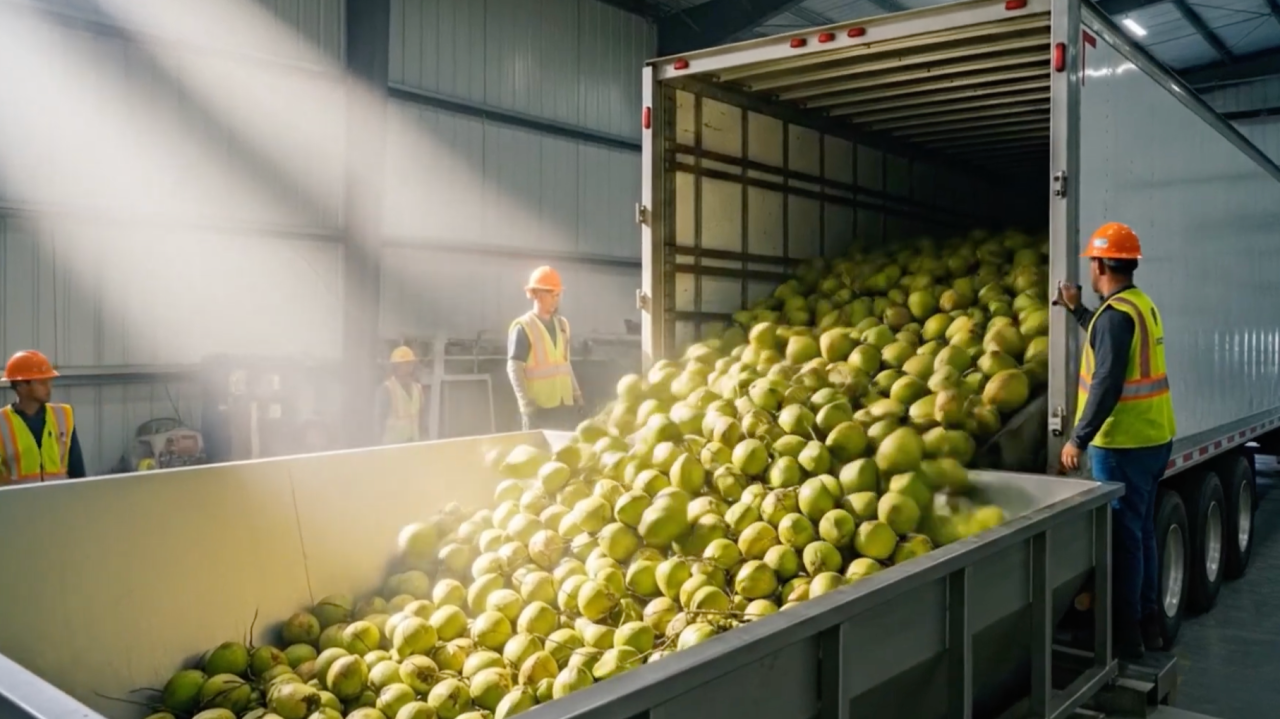
The global coconut industry is undergoing a meaningful transformation. What was once viewed largely as a commodity-driven sector is now evolving into a value-focused market shaped by processing capability, product versatility, and supply-chain reliability.
As demand grows for plant-based, clean-label, and multifunctional ingredients, coconuts are increasingly recognized as a strategic input across food, beverage, personal care, and industrial applications. At the center of this shift is value-added coconut processing — a development that is redefining how coconuts are sourced, priced, and positioned in global trade.
The Shift from Raw Materials to High-Value Coconut Ingredients
Historically, coconuts were exported primarily in raw or minimally processed forms. Today, the strongest growth is coming from processed coconut products designed to meet the technical and operational needs of modern manufacturers. These include formats such as:
- Desiccated and toasted coconut
- Coconut milk and cream derivatives
- Coconut water-based ingredients
- Coconut shell-derived materials, including activated carbon
Coconut Milk Powder: 60–65% Fat from the Mekong Delta
For producers looking for a clean coconut profile, high fat content, and a convenient format for recipe development, coconut milk powder at 60–65% fat is back in production in the Mekong Delta.
- 97% coconut milk, up to 65% fat, made from fresh selected coconuts, spray-dried, no preservatives
- Composition: 97% coconut milk, 2.5% maltodextrin (carrier), 0.5% acacia fiber (emulsifier)
- Applications: beverages, desserts, sauces, ready meals, instant products, ice cream, confectionery, functional nutrition, and plant-based concepts
Coconut Water: Nature's Oral Rehydration Solution
Scientists and survival medicine practitioners have long described fresh coconut water as "dry ocean water" — not as poetry, but as biochemistry. The electrolyte composition of fresh Mekong Delta coconut water (potassium, magnesium, calcium, sodium, phosphorus) is so closely aligned with human blood plasma osmolarity that it has been used historically as emergency intravenous fluid when medical supplies were unavailable.
Activated Carbon from Coconut Shell
Coconut shell-derived activated carbon is a powerful and environmentally beneficial adsorbent material. It is employed in air filtration, water purification, and as a component in the production of pharmaceuticals and cosmetics. The fibrous substance called coir, extracted from the coconut husk, can be used for soil improvement, erosion prevention, and as a substrate for horticulture.
Coconut Cream: Market Trends & Opportunities
Coconut cream is made by simmering shredded coconut meat with water, then straining it — the thick layer that rises to the top after chilling. Key market dynamics:
- Drivers: Rise in vegan and dairy-free diets; growing lactose intolerance awareness
- Opportunities: Expansion into functional foods — coconut cream is rich in MCTs
- Challenges: Price fluctuations in raw materials; competition from almond, oat, and soy alternatives
Organic Coconut Flour: A Nutritional Breakthrough
Organic coconut flour is more than just an alternative to traditional wheat flour — it is a nutritional breakthrough driving the global clean-eating movement. Our premium organic coconut flour follows a closed-loop manufacturing process:
- Sourcing: Processed entirely from selected coconut meat harvested from certified organic plantations
- Extraction: Obtained as a co-product during premium coconut oil production, after oil extraction via cold-pressing
- Finishing: The defatted coconut kernel is dried under strict temperature controls and finely milled into a soft, lightweight flour
From a circular economy perspective, defatted coconut flour represents a high-value co-product generated during virgin coconut oil (VCO) production — turning what was once industrial waste into a functional food ingredient rich in dietary fiber and protein.
Does Processing Capability Drive Coconut Market Growth?
Regions and suppliers that invest in coconut processing infrastructure are gaining a competitive edge in the global market. This transition supports:
- Higher export value per unit
- Reduced exposure to raw commodity price volatility
- Greater product customization for different industries
- Stronger long-term supply relationships
From a sourcing perspective, working with suppliers that control or closely manage processing reduces operational risk and improves supply-chain efficiency.