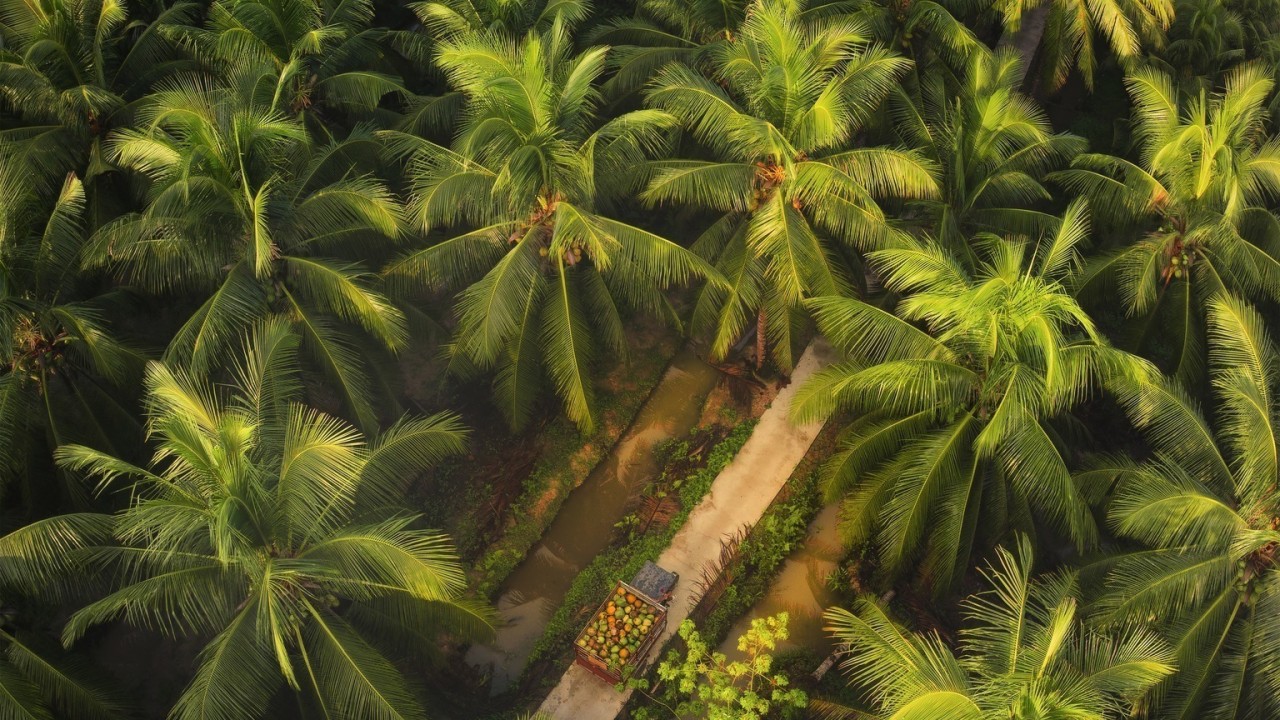
The unparalleled quality of Vietnamese coconut products — especially premium coconut oil — is deeply rooted in the unique terroir of the Mekong Delta, with Ben Tre Province serving as its historic epicenter. Known as the "Cradle of Coconuts," this region possesses a natural microclimate and geographical advantages that cannot be replicated anywhere else in the world.
A Region Designated for Greatness
The Mekong Delta is the key region possessing Vietnam's largest and most complete coconut supply chain, accounting for nearly 88% of the country's total coconut area with approximately 130,000 hectares. In 2024, Ben Tre — the "coconut capital" — led the region with over 72,000 hectares, serving as the largest center for coconut research and processing.
The remaining concentrated growing areas are located in Tien Giang, Tra Vinh, and Vinh Long; together with Ben Tre, this cluster accounts for 80% of the nation's total coconut cultivation area.
Also in 2024, the Ministry of Agriculture and Rural Development approved the Development Plan for Key Industrial Crops through 2030, officially designating coconuts as one of Vietnam's 6 key national industrial crops.
Three Core Elements of Exceptional Quality
1. Nutrient-Rich Alluvial Ecosystem
Nourished by the complex network of the Mekong River, which delivers a rich layout of annual organic silt, this natural mineral matrix allows coconut trees to thrive robustly — completely eliminating the dependency on chemical fertilizers. Every harvest cycle, the river replenishes what the coconut palm consumes: nitrogen, phosphorus, potassium, magnesium, and trace minerals that no synthetic fertilization program replicates with the same biological complexity.
2. Perfect Hydrological Balance
The unique interface of the coastal brackish water ecosystem, combined with an average of over 2,400 hours of tropical sunshine per year, creates an ideal growth-stress balance that stimulates the coconut trees to maximize nutrient accumulation. In the estuarine zones of Bến Tre, Trà Vinh, and Vĩnh Long, salinity fluctuates naturally between 0.5 and 5 parts per thousand across the growing season.
3. The "Premium Oil" Structural Breakthrough
Thanks to these specific terroir conditions, Mekong Delta coconuts develop a significantly thicker meat (endosperm). This structural advantage yields a superior concentration of Lauric Acid (the primary antimicrobial component) and MCTs (Medium-Chain Triglycerides), granting our coconut oil an outstanding thermal stability, a cleaner profile, and a characteristically rich, sweet aroma.
From the Delta to the World
By maintaining strict organic farming practices across these fertile wetlands, Vietnam does not just export coconut products — we deliver the pure, sustainable essence of the Mekong Delta directly to global markets. From SGF Sourcing as a global partner, we don't just export coconuts; we deliver the standardized, sustainable essence of the Mekong Delta to the global market.