
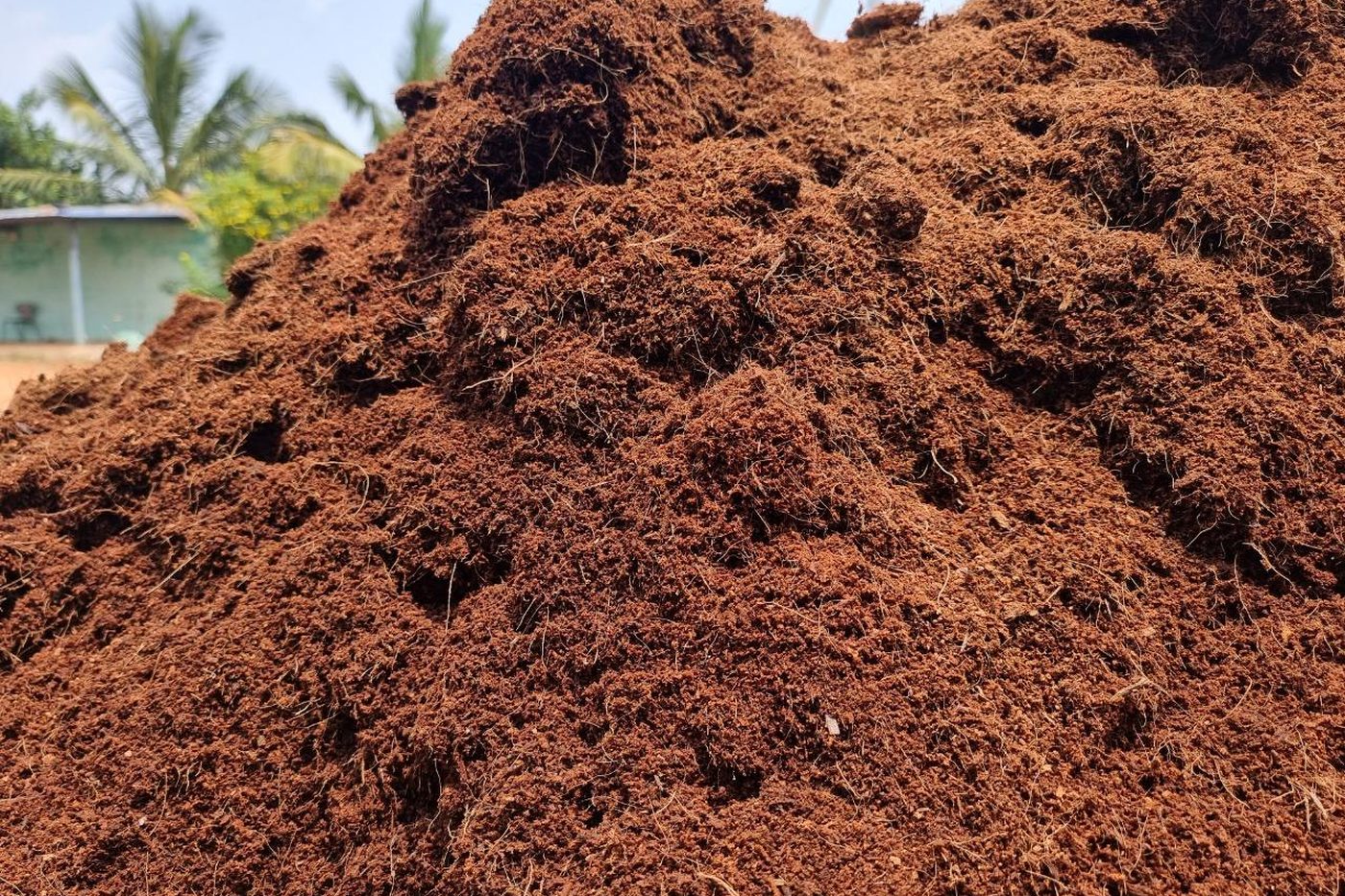
- Abundant, year-round raw material — the Mekong Delta is one of Asia’s largest coconut-producing regions, with stable husk supply not dependent on a single peak season
- Strategic logistics position — direct access to Ho Chi Minh City port, shorter shipping lanes to key Asia-Pacific, Middle East, and growing European buyers
- Processing options — loose cocopeat, compressed blocks, briquettes, and grow bags, with washed and buffered (low EC/pH-controlled) grades available for hydroponic-grade requirements
- Full export documentation — COA, Phytosanitary Certificate, Certificate of Origin, and third-party lab testing available upon request
Beyond Premium Cocopeat, we support buyers with product specification consulting, sample testing coordination, and flexible MOQs for both trial orders and long-term supply contracts — helping growers and distributors diversify their raw material sourcing beyond traditional origins.
We’re committed to positioning Vietnam as a trusted, scalable source for the global growing media industry.
Global Coco Peat Market to Reach USD 5.78 Billion by 2033
The global coco peat market, valued at approximately USD 4.8 billion in 2024, is projected to reach USD 5.78 billion by 2033, growing at a CAGR of 4.7% between 2026 and 2033. MarkWide Research
Primary Growth Drivers: Growth is underpinned by rising global demand for organic and sustainable substrates, especially in regions with expanding urban agriculture. The growth of export-oriented production in India, Indonesia, and the Philippines has played a key role in scaling supply and reducing costs, making coco peat more accessible worldwide. MarkWide Research
Demand-Side Shift: Demand is being shaped by the rising adoption of soilless cultivation techniques, the growth of vertical farms, and a broader global shift toward organic farming. The surge in hydroponic and aeroponic systems — particularly across North America and Europe — has created a high-value niche for premium coco peat products. MarkWide Research
Technological Advancements: Advancements in extraction and processing technology are improving yield efficiency, while infrastructure investment is reducing logistical bottlenecks — enabling larger export volumes to reach international buyers. MarkWide Research
Regional Analysis: Asia-Pacific continues to lead global supply, with strong demand growth in North America and Europe as sustainable agriculture and organic certification standards push buyers away from traditional peat moss.
What this means for buyers sourcing coco peat right now
As demand accelerates faster than many traditional supply origins can scale, buyers are actively diversifying sourcing beyond the usual India–Sri Lanka supply base — looking for new, reliable coconut-growing regions that can guarantee consistent EC/pH buffering, low salinity, and export-grade blocks/briquettes/loose substrate.
This is where Vietnam’s Mekong Delta is emerging as a credible alternative — abundant raw material, growing processing capacity, and a region still under-tapped relative to its potential.
Which of these parameters do you check first before purchasing cocopeat?
Here are 5 key physical parameters used in the cocopeat industry:
- Particle Size Distribution (PSD)What it means: The proportion of fine particles, medium particles and fibres.Typical commercial specification: Balanced particle distribution with minimal oversized particles for uniform root growth.
- Moisture ContentWhat it means: The amount of water present in the compressed block.Typical commercial range: 15–20% during packaging. Too dry can make blocks brittle, while excess moisture may cause premature expansion, mould risk and handling issues.
- Sand ContentWhat it means: The amount of mineral particles mixed with cocopeat.Typical commercial specification: Less than 2%. Lower sand content generally indicates a cleaner growing medium.
- Fibre ContentWhat it means: The percentage of coconut fibres present in the media.Typical commercial range: Depends on the application. Fine propagation media usually contains less fibre, while growing media for improved aeration may contain a higher fibre proportion.
- Expansion VolumeWhat it means: The amount of growing media produced after proper hydration.Typical commercial value: A 5 kg compressed cocopeat block commonly expands to around 75–80 litres, depending on moisture content, compression ratio and product grade.
The best cocopeat isn’t judged by one parameter. It’s the combination of PSD, moisture, sand content, fibre content and expansion consistency that determines overall quality.
In food, fresh is better. In cocopeat, “freshly processed” is a red flag.
Pith straight out of a green husk carries active phenolics and tannins, plus a large pool of easily degradable carbon. Used immediately as a growing medium, it does two things to your crop.
1. Nitrogen immobilisation
Coir pith sits at a very wide carbon-to-nitrogen ratio. Microbes feeding on that fresh, labile carbon pull available nitrogen out of the root zone to do it. Your plant gets what’s left: stunted growth, pale new leaves, and a nutrient plan that looks perfectly correct on paper.
2. Structural collapse
Unstable organic matter keeps breaking down after it is already in the bag. Pore structure disappears, the medium compacts, air porosity drops. The root zone you specified in month one is not the root zone you have in month four.
The standard: properly aged pith.
Typically three to six months or more, in managed and turned piles — not simply left in the open to re-wet through a rainy season. Ageing lets the labile carbon degrade and the phenolics leach out, so the material stabilises before it ever meets your crop.
It is not composting, and it should not be sold as such.
How to verify an ageing claim, because colour proves nothing:
- Ask for batch traceability and pile turn records, not a verbal “six months”.
- Request a nitrogen drawdown test on the batch you are buying.
- Run a germination bioassay yourself. Cress or lettuce seed on the expanded medium against a control. Seventy-two hours and one tray tell you more about phytotoxicity than any paragraph in a brochure.
The first question we ask when auditing a coir facility at SGF Sourcing is not about price or capacity. It is: how long has this pith been aged, and show me how you know.
Knowing what happens to the raw material before compression is the line between trading a commodity and assuring a quality.
Professional growers compare physical parameters.
Here are 3 key physical parameters used in the cocopeat industry:
- Particle Size Distribution (PSD)What it means: The proportion of fine particles, medium particles and fibres.Typical commercial specification: Balanced particle distribution with minimal oversized particles for uniform root growth.
- Moisture ContentWhat it means: The amount of water present in the compressed block.Typical commercial range: 15–20% during packaging. Too dry can make blocks brittle, while excess moisture may cause premature expansion, mould risk and handling issues.
- Sand ContentWhat it means: The amount of mineral particles mixed with cocopeat.Typical commercial specification: Less than 2%. Lower sand content generally indicates a cleaner growing medium.
Typical commercial value: A 5 kg compressed cocopeat block commonly expands to around 75–80 litres, depending on moisture content, compression ratio and product grade.
The best cocopeat isn’t judged by one parameter. It’s the combination of PSD, moisture, sand content, fibre content and expansion consistency that determines overall quality.
3 Common Misunderstandings Rooted in One Big Mistake.
- Using Untreated Coco Coir Raw coco coir naturally contains very high levels of salt and potassium (high EC). If it is not properly washed and buffered, plant roots will suffer from “salt burn” within the very first week—even if the plant appears normal on the outside.
- Watering Based on Soil Habits Coco coir retains water much better than traditional soil. Sticking to an old watering schedule = waterlogged roots, lack of oxygen, and root rot silently developing underground.
- Failing to Provide Adequate Nutrition Unlike soil—which has a natural ecosystem of microorganisms and minerals—coco coir is almost completely “empty” of nutrients. Everything the plant needs must come directly from fertilizers; there is no “backup supply” from the medium.
A Certificate of Analysis is the fastest way to confirm quality.
Here are 5 field checks buyers use when COA is missing:
- EC Test (1:1.5 Water Extract)What it means: A direct reading of soluble salts in the medium — the single biggest cause of seedling failure in coir.How to check: Mix 1 part hydrated cocopeat with 1.5 parts distilled water, stir, rest 15 minutes, read with a handheld EC meter.Typical commercial range: Below 0.5 mS/cm for washed grades used in propagation. Above 1.0 mS/cm indicates insufficient washing and requires leaching before planting.
- pH CheckWhat it means: Whether your nutrient recipe will actually deliver the nutrients you calculated.How to check: Same water extract, pH pen.Typical commercial range: 5.5–6.8. Readings above 7.0 often point to sea-water washing or heavy sand contamination.
- Jar Sedimentation Test (Sand & Grit)What it means: How much mineral content you are paying for instead of growing medium.How to check: Hydrate a sample in a clear jar of water, agitate, let it settle. Sand drops to the bottom within minutes and is easy to see and weigh once dried.Typical commercial specification: Under 2%. A visible layer of grit is a rejection signal, not a negotiation point.
- Expansion & Yield TestWhat it means: Verification that the block delivers the volume the invoice is based on.How to check: Hydrate one full block under normal conditions and measure the expanded volume.Typical commercial value: A 5 kg block should reach roughly 75–80 litres. Consistent short yield means over-moisture at packing or under-compression.
- Wet-Out Speed & OdourWhat it means: Maturity and ageing of the pith. Fresh, unaged material repels water and immobilises nitrogen.How to check: Time how long dry cocopeat takes to absorb water fully, and smell the hydrated sample.What to look for: Even, rapid wetting with a clean earthy smell. Hydrophobic patches, sour or ammonia notes suggest fresh or poorly stored material.
Most people recognize cocopeat as a 5 kg compressed block.
But that’s just one of the many commercial product formats used in modern horticulture.
Here are four of the most common commercial cocopeat formats used by growers:
- Compressed Cocopeat Blocks (5 kg / 3 kg / 2 kg)Designed for efficient storage, transportation, and export. After hydration, the blocks expand into loose cocopeat. While 5 kg blocks are widely used for commercial production, smaller block sizes are also available for growers who require lower expansion volumes and easier handling.
- Ready-to-Use format - (50l bag)Already expanded and ready for immediate use. Commonly used in nurseries, seedling production, potting media preparation, greenhouse operations, landscaping, and container cultivation.
- Grow BagsPre-filled with cocopeat/cocochips and designed as the final growing medium for greenhouse vegetables, berries, flowers, and other high-value horticultural crops. They support efficient fertigation and healthy root development.
- Open-Top BagsSimilar to grow bags but supplied with an open planting surface, allowing seedlings to be transplanted directly into the growing media. Widely used in protected cultivation and hydroponic production systems.
Within each category, there are many more variations based on dimensions, particle size, blend composition, expansion capacity, crop requirements, cultivation systems, and customer specifications.
And this is just the beginning.